Objects obscuring bird photos

Don’t you hate it when lighthouses and vegetation obscure your bird shots?

Blue Angels - Pensacola, FL - July 2010
Nikon D300, 500mm f/4 lens
1/800 sec at f/8, ISO 250


Fort Pickens, located on Pensacola Beach on the Gulf Islands National Seashore, was one of my favorite birding spots when I lived in Pensacola. The Naval Air Station that is the home base of the Blue Angels is only a couple of miles from the fort. The segment of Pensacola Bay closest to the pass into the Gulf of Mexico separates the Fort and the Naval Air Station. I had many opportunities to photograph the Blue Angels during their practice sessions when I was birding at Fort Pickens.


David Sparks

I retired in 2005 after 40 years of research and teaching at the University of Alabama in Birmingham (24 years), the University of Pennsylvania (8 years) and the Baylor College of Medicine (8 years). Photography is my retirement hobby.

Nature photography, especially bird photography, combines a number of things that I really enjoy: bird-watching, being outdoors, photography, travel, messing about with computers, and learning new skills and concepts.  I now spend much of my time engaged in these activities.

David Sibley in the preface to The Sibley Guide to Birds wrote "Birds are beautiful, in spectacular as well as subtle ways; their colors, shapes, actions, and sounds are among the most aesthetically pleasing in nature."  My goal is to acquire images that capture the beauty and uniqueness of selected species as well as images that highlight the engaging behaviors the birds exhibit. 

Experimenting with a different way of displaying images on this blog site

Click here to view more photos

David Sparks

I retired in 2005 after 40 years of research and teaching at the University of Alabama in Birmingham (24 years), the University of Pennsylvania (8 years) and the Baylor College of Medicine (8 years). Photography is my retirement hobby.

Nature photography, especially bird photography, combines a number of things that I really enjoy: bird-watching, being outdoors, photography, travel, messing about with computers, and learning new skills and concepts.  I now spend much of my time engaged in these activities.

David Sibley in the preface to The Sibley Guide to Birds wrote "Birds are beautiful, in spectacular as well as subtle ways; their colors, shapes, actions, and sounds are among the most aesthetically pleasing in nature."  My goal is to acquire images that capture the beauty and uniqueness of selected species as well as images that highlight the engaging behaviors the birds exhibit. 

Greater Sage-Grouse photos

While cleaning out folders in my bloated Lightroom catalog, I found a lot of unprocessed raw files of photos taken on a photo tour led by Greg Lavaty in 2014. He called it a chicken run. The goal was to get photos of White-tailed Ptarmigan, Greater Sage Grouse, Sharp-tailed Grouse, Greater and Lesser Prairie-Chicken and the complex breeding rituals of the Grouse and Prairie-Chickens.

All of the photos shown are of Greater Sage-Grouse seen at a lek near Walton, CO on April 2, 2014.

All shots were taken with a Nikon D7100 camera and a 500mm f/4 lens shot at f/5.6. Shutter speeds varied from 1/1000 sec to 1/2500 sec and ISO from 1000 to 1250..


Pointed tail. Legs with feathers. Yellow patch over the eye. White breast. Dark brown throat, Black Belly. Two yellow sacs on the neck.


Females, want to see how fit I am? Look at my spiky tail feathers and the size of my puffed-up chest.


And …. I earned this valuable territory in the middle of the lek by chasing off many less-fit males not worthy of your attention.


In a lek, males compete with each other through a series of spectacular displays, calls, and sparring for the coveted innermost territories on the lek. The one or two males most successful in attaining and defending these small territories typically perform about 90% of the matings that occur on the lek.


David Sparks

I retired in 2005 after 40 years of research and teaching at the University of Alabama in Birmingham (24 years), the University of Pennsylvania (8 years) and the Baylor College of Medicine (8 years). Photography is my retirement hobby.

Nature photography, especially bird photography, combines a number of things that I really enjoy: bird-watching, being outdoors, photography, travel, messing about with computers, and learning new skills and concepts.  I now spend much of my time engaged in these activities.

David Sibley in the preface to The Sibley Guide to Birds wrote "Birds are beautiful, in spectacular as well as subtle ways; their colors, shapes, actions, and sounds are among the most aesthetically pleasing in nature."  My goal is to acquire images that capture the beauty and uniqueness of selected species as well as images that highlight the engaging behaviors the birds exhibit. 

Great Blue Heron and Reflection

I found this photo of a Great Blue Heron while cullng images in my Lightroom Catalog.

Click on the image to make the bird a tiny bit larger.

Great Blue Heron - Laguna Atascosa NWR, TX - November 2010
Nikon D700, 24-70mm f/2.8 lens at 60mm
1/320 sec at f/13, ISO 200


David Sparks

I retired in 2005 after 40 years of research and teaching at the University of Alabama in Birmingham (24 years), the University of Pennsylvania (8 years) and the Baylor College of Medicine (8 years). Photography is my retirement hobby.

Nature photography, especially bird photography, combines a number of things that I really enjoy: bird-watching, being outdoors, photography, travel, messing about with computers, and learning new skills and concepts.  I now spend much of my time engaged in these activities.

David Sibley in the preface to The Sibley Guide to Birds wrote "Birds are beautiful, in spectacular as well as subtle ways; their colors, shapes, actions, and sounds are among the most aesthetically pleasing in nature."  My goal is to acquire images that capture the beauty and uniqueness of selected species as well as images that highlight the engaging behaviors the birds exhibit. 

Secretive Marsh Birds - Sora

I am in the process of constructing a collection of images that will be labelled SECRETIVE MARSH BIRDS. Ironically, all parts of the body except those that are submerged are exposed in my favorite shots of the very secretive Sora (Porzana carolina).

Click on each image to see a slightly larger version.


Sora - Fort Pickens Gulf Islands National Seashore (FL) - October 2010
Nikon D300s, 500mm f/4 lens
1/640 sec at f/4, ISO 800

The Sora is a member of the Family Rallidae which also includes other rails, Gallinules and Coots. Sora primarily eat seeds for which their short, stubby yellow bill is well suited.


Sora - Fort Pickens Gulf Islands National Seashore (FL) - October 2010
Nikon D300s, 500mm f/4 lens + 1.4x teleconverter
1/640 sec at f/8, ISO 400

I have learned some interesting things while reading about the rails and bitterns. For survey and conservation purposes rails and bitterns are among those listed as secretive marsh birds. In general, estimates of the numbers of marsh birds have been and continue to be declining. It is not surprising that the populations of many marsh birds have declined in North America. About half of the wetlands in the U.S. have been lost over the past 200 years. In Louisiana, about one-quarter of the state’s wetlands – an area the size of Delaware – have been lost since the 1930s.


Sora - Anahuac NWR (TX) - May 2011
Nikon D300, 500mm f/4 lens + 1.4x teleconverter
1/640 sec at f/4.5, ISO 250

Several descriptions of the plumage and behavior of Sora that I read described their habitat as emergent wetlands. “Emergent wetland means a wetland with at least thirty (30) percent of the surface area covered by erect, rooted, herbaceous vegetation extending above the water surface as the uppermost vegetative strata.” The herbaceous plants are hydrophytic or water-adapted. The vegetation is rooted below the water’s surface and either stands erect above the water (e.g., cattails) or grows at the surface (e.g., lily pads). Link


Sora - St. Marks NWR (FL) - November 2012
Nikon D300s, 300mm f/2.8 lens + 1.7x teleconverter
1/320 sec at f/5.6, ISO 1250

Virginia Rails, Soras, and King Rails are game species in many states. The following description of soras is one I found in a hunting magazine. “Soras are shy little birds. They are small, about the size of an English sparrow and sport a slate-gray chest and belly, brown-white-black speckled wings and back. Mother Nature outfitted soras with a black bib and face mask accentuated by a bright yellow bill. Their long legs are greenish gray and dangle awkwardly when rails flush and take wing. Once in the air, soras are not strong flyers, nor do they fly very far before settling back down. Their flight appears almost labored. Preferred sora habitat includes cattail marshes and moist soil environments where they can feast on seeds, rice, insects and aquatic invertebrates.” Link


Sora preening - Wakodahatchee Wetlands (FL) - January 2014
Nikon D7100, 500mm f/4 lens + 1.4x teleconverter
1/1250 sec at f/8, ISO 640

More about secretive marsh birds and their habitat in the next post.


Sora preening - Wakodahatchee Wetlands (FL) - January 2014
Nikon D7100, 500mm f/4 lens + 1.4x teleconverter
1/1000 sec at f/8, ISO 640


Sora - Fort Pickens Gulf Islands National Seashore (FL) - April 2013
Nikon D7100, 300mm f/4 lens + 1.7x teleconverter
1/2500 sec at f/8, ISO 1600


David Sparks

I retired in 2005 after 40 years of research and teaching at the University of Alabama in Birmingham (24 years), the University of Pennsylvania (8 years) and the Baylor College of Medicine (8 years). Photography is my retirement hobby.

Nature photography, especially bird photography, combines a number of things that I really enjoy: bird-watching, being outdoors, photography, travel, messing about with computers, and learning new skills and concepts.  I now spend much of my time engaged in these activities.

David Sibley in the preface to The Sibley Guide to Birds wrote "Birds are beautiful, in spectacular as well as subtle ways; their colors, shapes, actions, and sounds are among the most aesthetically pleasing in nature."  My goal is to acquire images that capture the beauty and uniqueness of selected species as well as images that highlight the engaging behaviors the birds exhibit. 

American Avocet Takeoff Sequence

I am still culling images I obtained on my birding trip to the Bolivar Peninsula (TX) in April. This is one of my favorite birding locations, but on most days during my visit, the wind, tide, and cloud conditions were not favorable for finding and photographing shorebirds. This lowered my expectations of finding many “keepers” in the files from that trip and my enthusiasm for spending a lot of time sorting the photos. But, I am finding a few pleasant surprises. .


American Avocet taking off sequence. Bolivar Peninsula (TX). April 2021
Olympus E-M1X camera with 150-400mm f4.5 TC lens @ 500mm.
Settings were the same for the three photos: 1/1600 sec at f/5.6, ISO 200

Click on the image for a slightly larger view.


David Sparks

I retired in 2005 after 40 years of research and teaching at the University of Alabama in Birmingham (24 years), the University of Pennsylvania (8 years) and the Baylor College of Medicine (8 years). Photography is my retirement hobby.

Nature photography, especially bird photography, combines a number of things that I really enjoy: bird-watching, being outdoors, photography, travel, messing about with computers, and learning new skills and concepts.  I now spend much of my time engaged in these activities.

David Sibley in the preface to The Sibley Guide to Birds wrote "Birds are beautiful, in spectacular as well as subtle ways; their colors, shapes, actions, and sounds are among the most aesthetically pleasing in nature."  My goal is to acquire images that capture the beauty and uniqueness of selected species as well as images that highlight the engaging behaviors the birds exhibit. 

Red-winged Blackbird — Takeoff and in Flight

I spent two and one-half days exploring the Cheyenne Bottoms WA and Quivira NWR-Big Salt Marsh in Kansas last week. These wetlands are premier sites for viewing shorebirds in the interior United States, especially in the spring. I expected to spend most of my time there photographing shorebirds, as I has done on a visit a couple of years ago. The shorebirds were there, as recent E-bird reports indicated. But the water levels were low and most of the shorebirds, visible using spotting scopes, were a long distance from the dikes and roads accessible to viewers.

Red-winged Blackbird - Cheyenne Bottoms WA - May 2021

The 5 images in this post were obtained using the Olympus E-M1X camera
with 150-400mm f4.5 TC lens @ 250mm.
Settings were the same: 1/2000 sec at f/6.3, ISO 800

The edges of the dikes and roads were not devoid of birds. Swallows, Blackbirds, Dickcissels, Kingbirds, Meadowlarks, and Grackles were active, but skitish because of the low traffic density in these wetlands. I decided to devote my effort to trying to capture takeoff and flight images of the birds active on the edges of the areas accessible to visitors instead of the distant shorebirds.


One reason for this decision (in addition to the photographic inaccessibility of the shorebirds) was to gain experience with the Pro Capture mode available on some Olympus cameras. Pro Capture works by continuously taking images and saving them in temporary memory when the shutter is “half pressed.” The images in the buffer are deleted if the shutter is released before being fully activated. When the shutter button is fully activated, images in the buffer plus addition images collected while the shutter remains depressed are saved. While this mode captures events usually lost during the reaction time of the photographer, the photographer makes a number of decisions about camera settings that affect the outcome. Among these are choice of the field of view (how much space around the bird is included in the frame), shutter speed, number and location of the active focus points, and the aperture setting which affects the depth of field. I found myself in a situation that provided an excellent opportunity to practice using the Pro Capture mode. Doing so had been on my (should be laminated) photographic ToDo list for quite some time. Some of the results obtained are show below. More will be illustrated in follow-up blog posts.


David Sparks

I retired in 2005 after 40 years of research and teaching at the University of Alabama in Birmingham (24 years), the University of Pennsylvania (8 years) and the Baylor College of Medicine (8 years). Photography is my retirement hobby.

Nature photography, especially bird photography, combines a number of things that I really enjoy: bird-watching, being outdoors, photography, travel, messing about with computers, and learning new skills and concepts.  I now spend much of my time engaged in these activities.

David Sibley in the preface to The Sibley Guide to Birds wrote "Birds are beautiful, in spectacular as well as subtle ways; their colors, shapes, actions, and sounds are among the most aesthetically pleasing in nature."  My goal is to acquire images that capture the beauty and uniqueness of selected species as well as images that highlight the engaging behaviors the birds exhibit. 

Red-headed Woodpecker and Red-winged Blackbird Interaction

Once upon a time (last Thursday), on a Wildlife Area not TOO far away (Cheyenne Bottoms WA in Kansas), I spotted a Red-headed Woodpecker feeding while using the wooden fence posts along one of the access roads as temporary perches before launching attacks on prey.

Red-headed Woodpecker - Cheyenne Bottoms WA, Kansas - May 2021
Olympus E-M1X with 150-400mm f4.5 TC lens @ 500mm
1/3200 sec at f/6.3, ISO 4000


I adjusted the camera settings to optimize acquisition of images of the woodpecker in flight and watched the behavior of the bird carefully through the viewfinder looking for any indication the bird was about to fly. The appearance of a Red-winged Blackbird in the viewfinder was a complete surprise.

Olympus E-M1X with 150-400mm f4.5 TC lens @ 500mm
1/3200 sec at f/6.3, ISO 4000


Even more surprisng was seeing the blackbird land on the post, and then appear to “say something” to the woodpecker before it took off while the woodpecker was changing positions on the post..

Olympus E-M1X with 150-400mm f4.5 TC lens @ 500mm
1/3200 sec at f/6.3, ISO 4000
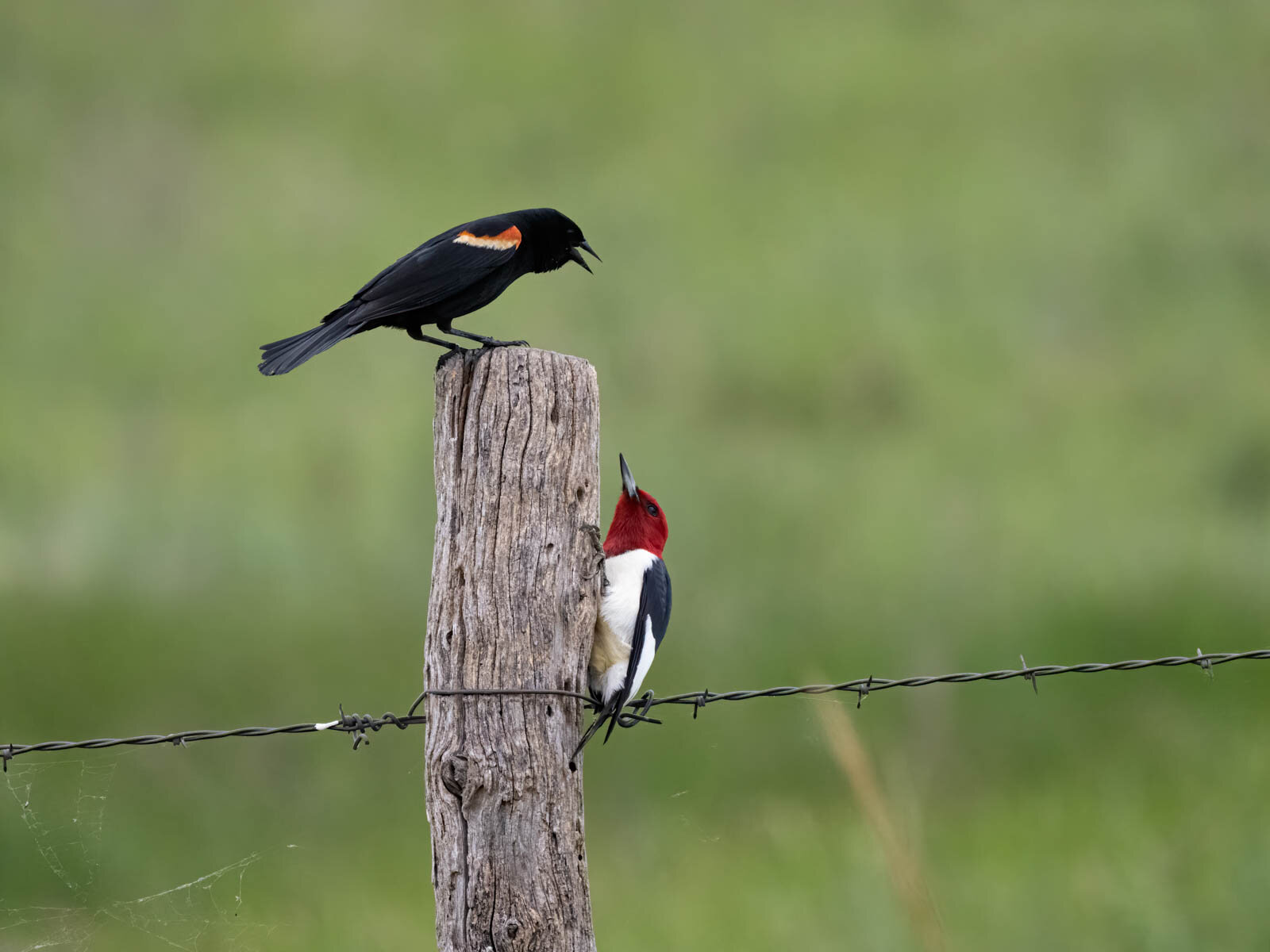

Olympus E-M1X with 150-400mm f4.5 TC lens @ 419mm
1/3200 sec at f/6.3, ISO 4000


Olympus E-M1X with 150-400mm f4.5 TC lens @ 383mm
1/3200 sec at f/6.3, ISO 4000


This behavioral sequence triggered my curiosity about interspecies communication in birds. An interesting discussion of this topic can be found using this LINK.


Olympus E-M1X with 150-400mm f4.5 TC lens @ 500mm
1/3200 sec at f/6.3, ISO 4000

This is the first frame in the burst of exposures after the blackbird flew away. It would be anthropomorphic to label this a Pictorial Definition of Relief. An enlargement of the woodpecker’s head is shown below.

David Sparks

I retired in 2005 after 40 years of research and teaching at the University of Alabama in Birmingham (24 years), the University of Pennsylvania (8 years) and the Baylor College of Medicine (8 years). Photography is my retirement hobby.

Nature photography, especially bird photography, combines a number of things that I really enjoy: bird-watching, being outdoors, photography, travel, messing about with computers, and learning new skills and concepts.  I now spend much of my time engaged in these activities.

David Sibley in the preface to The Sibley Guide to Birds wrote "Birds are beautiful, in spectacular as well as subtle ways; their colors, shapes, actions, and sounds are among the most aesthetically pleasing in nature."  My goal is to acquire images that capture the beauty and uniqueness of selected species as well as images that highlight the engaging behaviors the birds exhibit. 

Northern Harrier - Posing

Because of the windy conditions on my recent trip to the Bolivar Peninsula, I thought I might have an opportunity to get some flight shots of Northern Harriers. Instead, the only Harrier photo ops I had were of the birds perched on a post. Images of the birds taking off were either rump shots or of the vehicle that initiated the take-off. I am not complaining. The two Harriers, or the same Harrier on different days, were/was very cooperative allowing me to move my blind (the car) closer than usual and adopting a variety of poses. The 5 images shown below are of the same bird. I may later post images taken on a different day and request opinions about the possibility of it being the same bird.

Northern Harrier - Bolivar Peninsula, TX - April 2021
Olympus E-M1X with 150-400mm f4.5 TC lens @ 400mm
1/2000 sec at f/5.6, ISO 1600


Northern Harrier - Bolivar Peninsula, TX - April 2021
Olympus E-M1X with 150-400mm f4.5 TC lens @ 400mm
1/2000 sec at f/5.6, ISO 1250


Northern Harrier - Bolivar Peninsula, TX - April 2021
Olympus E-M1X with 150-400mm f4.5 TC lens @ 350mm
1/2000 sec at f/5.6, ISO 1000


Northern Harrier - Bolivar Peninsula, TX - April 2021
Olympus E-M1X with 150-400mm f4.5 TC lens @ 335mm
1/2000 sec at f/7.1, ISO 3200


Northern Harrier - Bolivar Peninsula, TX - April 2021
Olympus E-M1X with 150-400mm f4.5 TC lens @ 335mm
1/2000 sec at f/7.1, ISO 3200

David Sparks

I retired in 2005 after 40 years of research and teaching at the University of Alabama in Birmingham (24 years), the University of Pennsylvania (8 years) and the Baylor College of Medicine (8 years). Photography is my retirement hobby.

Nature photography, especially bird photography, combines a number of things that I really enjoy: bird-watching, being outdoors, photography, travel, messing about with computers, and learning new skills and concepts.  I now spend much of my time engaged in these activities.

David Sibley in the preface to The Sibley Guide to Birds wrote "Birds are beautiful, in spectacular as well as subtle ways; their colors, shapes, actions, and sounds are among the most aesthetically pleasing in nature."  My goal is to acquire images that capture the beauty and uniqueness of selected species as well as images that highlight the engaging behaviors the birds exhibit. 

Great Egrets - Greeting

Four photos of a Great Egret returning to the nest and being greeted by the mate.
Smith Oaks Rookery, High Island TX, April 2021.
Camera: Olympus E-M1X Lens: 150-400mm f4.5 TC lens @ 284mm
Settings for all four images: 1/2000 sec at f/5.6, ISO 800.

When photographing birds at a rookery, I try to locate a nest near the top of the nesting structure. The male (usually) returning from a flight to gather nesting material or food, will usually approach the nest on a path that is free of foreground obstructions. The female will often stand to greet the returnee and, thereby, rise above some of branches and twigs that surround the nest. This behavior provides a nice photo-op.


David Sparks

I retired in 2005 after 40 years of research and teaching at the University of Alabama in Birmingham (24 years), the University of Pennsylvania (8 years) and the Baylor College of Medicine (8 years). Photography is my retirement hobby.

Nature photography, especially bird photography, combines a number of things that I really enjoy: bird-watching, being outdoors, photography, travel, messing about with computers, and learning new skills and concepts.  I now spend much of my time engaged in these activities.

David Sibley in the preface to The Sibley Guide to Birds wrote "Birds are beautiful, in spectacular as well as subtle ways; their colors, shapes, actions, and sounds are among the most aesthetically pleasing in nature."  My goal is to acquire images that capture the beauty and uniqueness of selected species as well as images that highlight the engaging behaviors the birds exhibit. 

Snowy Egret Skirmish

It is not unusual to see Snowy Egrets fighting for breeding territories and I observed their territorial disputes several times during my recent visit to Bolivar Peninsula and the Smith Oaks rookery at High Island, TX. But, only once did the disputes occur close enough to where I was stationed for me to try to photograph the behavior. The 9 images I captured of that skirmish are shown below.

Carla Brennan (https://carlabrennan.com/) posted photos of Snowy Egrets having a territorial dispute and described the experience as being "like watching angels break out into a fistfight."

Click on each image for a slightly larger view.

Snowy Egrets - Smith Oaks Rookery, High Island, TX - April 2021

The photos were all taken with an Olympus E-M1X camera, a 150-400mm f4.5 TC lens @ 360 - 419 mm at 1/2000 sec at f/5.6, ISOs 320-640.


David Sparks

I retired in 2005 after 40 years of research and teaching at the University of Alabama in Birmingham (24 years), the University of Pennsylvania (8 years) and the Baylor College of Medicine (8 years). Photography is my retirement hobby.

Nature photography, especially bird photography, combines a number of things that I really enjoy: bird-watching, being outdoors, photography, travel, messing about with computers, and learning new skills and concepts.  I now spend much of my time engaged in these activities.

David Sibley in the preface to The Sibley Guide to Birds wrote "Birds are beautiful, in spectacular as well as subtle ways; their colors, shapes, actions, and sounds are among the most aesthetically pleasing in nature."  My goal is to acquire images that capture the beauty and uniqueness of selected species as well as images that highlight the engaging behaviors the birds exhibit. 

Smallish Great Egrets - Smith Oaks Rookery, High Island, TX - April 2021

It is difficult to get open looks of the eggs and chicks in the nests at the Smith Oaks Rookery. I did manage to obtain a few images in which parts of the birds were not obscured. .

Great Egrets - Smith Oaks Rookery, High Island, TX -April 2021

Olympus E-M1X camera
150-400mm f4.5 TC lens @ 236 mm
1/2000 sec at f/5.6, ISO 1000


Great Egrets - Smith Oaks Rookery, High Island, TX -April 2021

Olympus E-M1X camera
150-400mm f4.5 TC lens @ 445 mm
1/2000 sec at f/7.1, ISO 1250


Great Egrets - Smith Oaks Rookery, High Island, TX -April 2021

Olympus E-M1X camera
150-400mm f4.5 TC lens @500 mm (built-in tc employed)
1/2000 sec at f/6.3, ISO 4000


Great Egrets - Smith Oaks Rookery, High Island, TX -April 2021

Olympus E-M1X camera
150-400mm f4.5 TC lens @500 mm (built-in tc employed)
1/2000 sec at f/6.3, ISO 4000


Great Egrets - Smith Oaks Rookery, High Island, TX -April 2021

Olympus E-M1X camera
150-400mm f4.5 TC lens @419 mm (built-in tc employed)
1/2500 sec at f/6.3, ISO 4000

David Sparks

I retired in 2005 after 40 years of research and teaching at the University of Alabama in Birmingham (24 years), the University of Pennsylvania (8 years) and the Baylor College of Medicine (8 years). Photography is my retirement hobby.

Nature photography, especially bird photography, combines a number of things that I really enjoy: bird-watching, being outdoors, photography, travel, messing about with computers, and learning new skills and concepts.  I now spend much of my time engaged in these activities.

David Sibley in the preface to The Sibley Guide to Birds wrote "Birds are beautiful, in spectacular as well as subtle ways; their colors, shapes, actions, and sounds are among the most aesthetically pleasing in nature."  My goal is to acquire images that capture the beauty and uniqueness of selected species as well as images that highlight the engaging behaviors the birds exhibit. 

Great Egrets Displaying - Smith Oaks Rookery, High Island, TX - April 2021

Click on landscape oriented photos for a slightly larger view.
Go to the text following the last photo for an overview of my April birding trip to Texas.

Great Egret - Smith Oaks Rookery, High Island, TX -April 2021

Olympus E-M1X camera
150-400mm f4.5 TC lens @ 406 mm
1/2500 sec at f/5.6, ISO 320


Great Egret - Smith Oaks Rookery, High Island, TX -April 2021

Olympus E-M1X camera
150-400mm f4.5 TC lens @320 mm
1/4000 sec at f/5.6, ISO 500


Great Egret - Smith Oaks Rookery, High Island, TX -April 2021

Olympus E-M1X camera
150-400mm f4.5 TC lens @350 mm
1/4000 sec at f/5.6, ISO 500


Great Egret - Smith Oaks Rookery, High Island, TX -April 2021

Olympus E-M1X camera
150-400mm f4.5 TC lens @275 mm
1/1250 sec at f/5.6, ISO 200

The Gulf Coast of Texas is one of my favorite bird photography locations, but this was not my most productive trip. I started the drive to Texas early one morning. I stopped at a McDonalds 4 blocks from the condo for an Egg McMuffin and a cup of coffee. A car in the "pick up your order" station suddenly put his car in reverse and backed into me at the "pay for your order" station. He had received incorrect change. There was no detectable damage to my bumper. Later that day in New Mexico, the wind was blowing so much soil across the highway that my lane detector system stopped working. A little later, the density of the tumbleweeds being blown across the road was so great, the automatic braking system was activated. For the entire two weeks there were basically only 3 or 4 low tides during daylight hours. Those occurred early in the morning when, from the dike that extends 5 miles out into the gulf to protect the Galveston ship channel, the sun was behind the birds. The dike is usually one of my favorite "perches" for photographing the wading birds. The normal tidal system was in effect, of course, but the wind was blowing onto shore so strongly that the predicted low tide water levels never happened. My photos of "shore" birds were obtained from fields pretty far inland. Fortunately the High Island rookery was very active and I spent a lot of time there. On the drive back to Colorado, a rock hit the windshield and produced a crack that grew to about 24 inches in length by the time I arrived at the condo. I enjoyed the trip! it was great to get out of the condo, to listen to the wind, to measure the depth of the water covering the roads to some of my birding spots by noting how much of the legs of the Yellowlegs, Stilts, and Willets feeding in the water on the roads was exposed, and to listen to the imaginary clicks of my mirrorless camera.

David Sparks

I retired in 2005 after 40 years of research and teaching at the University of Alabama in Birmingham (24 years), the University of Pennsylvania (8 years) and the Baylor College of Medicine (8 years). Photography is my retirement hobby.

Nature photography, especially bird photography, combines a number of things that I really enjoy: bird-watching, being outdoors, photography, travel, messing about with computers, and learning new skills and concepts.  I now spend much of my time engaged in these activities.

David Sibley in the preface to The Sibley Guide to Birds wrote "Birds are beautiful, in spectacular as well as subtle ways; their colors, shapes, actions, and sounds are among the most aesthetically pleasing in nature."  My goal is to acquire images that capture the beauty and uniqueness of selected species as well as images that highlight the engaging behaviors the birds exhibit. 

Baltimore Oriole - Smith Oaks Bird Sanctuary - High Island, TX - May 19, 2021

The tide and weather were both terrible for photographing shorebirds during my recent trip to the Bolivar Peninsula of Texas. But the birds at the nearby Smith Oaks Rookery and Bird Sanctuary did not abandon the area because of the weather. The sanctuary is heavily wooded and the light levels are low even when the clouds are not obscuring the sun. When it is overcast, ISOs rocket and mandatory noise reduction obscures detail. But I was pleased to get a couple of shots of the Oriole in the open, even if the detail in the images is reduced.

Olympus E-M1X camera and 150-400mm f4.5 TC lens @234mm
1/1250 sec at f/5.6, ISO 4000

Olympus E-M1X camera and 150-400mm f4.5 TC lens @234mm
1/1250 sec at f/5.6, ISO 4000

David Sparks

I retired in 2005 after 40 years of research and teaching at the University of Alabama in Birmingham (24 years), the University of Pennsylvania (8 years) and the Baylor College of Medicine (8 years). Photography is my retirement hobby.

Nature photography, especially bird photography, combines a number of things that I really enjoy: bird-watching, being outdoors, photography, travel, messing about with computers, and learning new skills and concepts.  I now spend much of my time engaged in these activities.

David Sibley in the preface to The Sibley Guide to Birds wrote "Birds are beautiful, in spectacular as well as subtle ways; their colors, shapes, actions, and sounds are among the most aesthetically pleasing in nature."  My goal is to acquire images that capture the beauty and uniqueness of selected species as well as images that highlight the engaging behaviors the birds exhibit. 

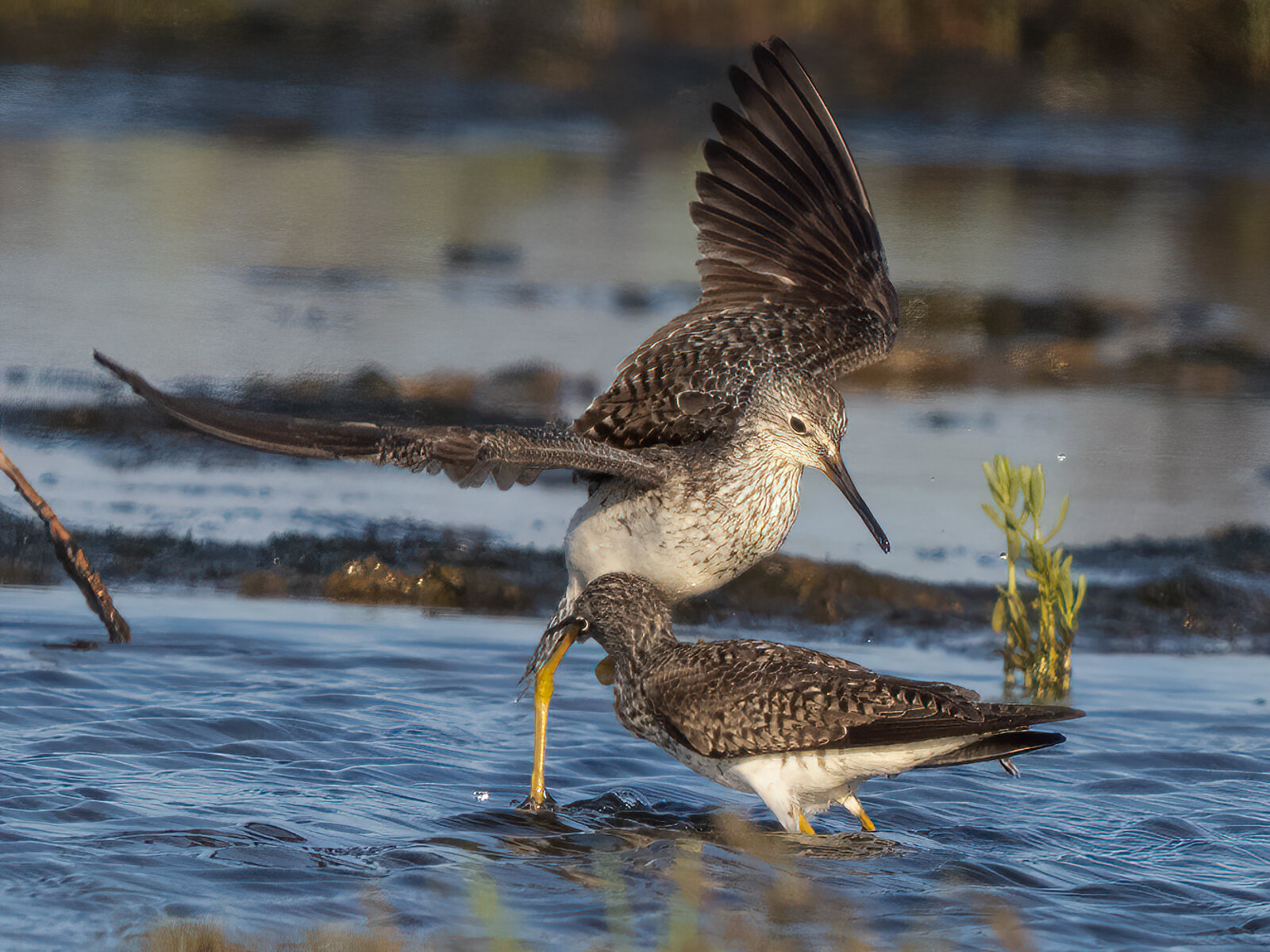
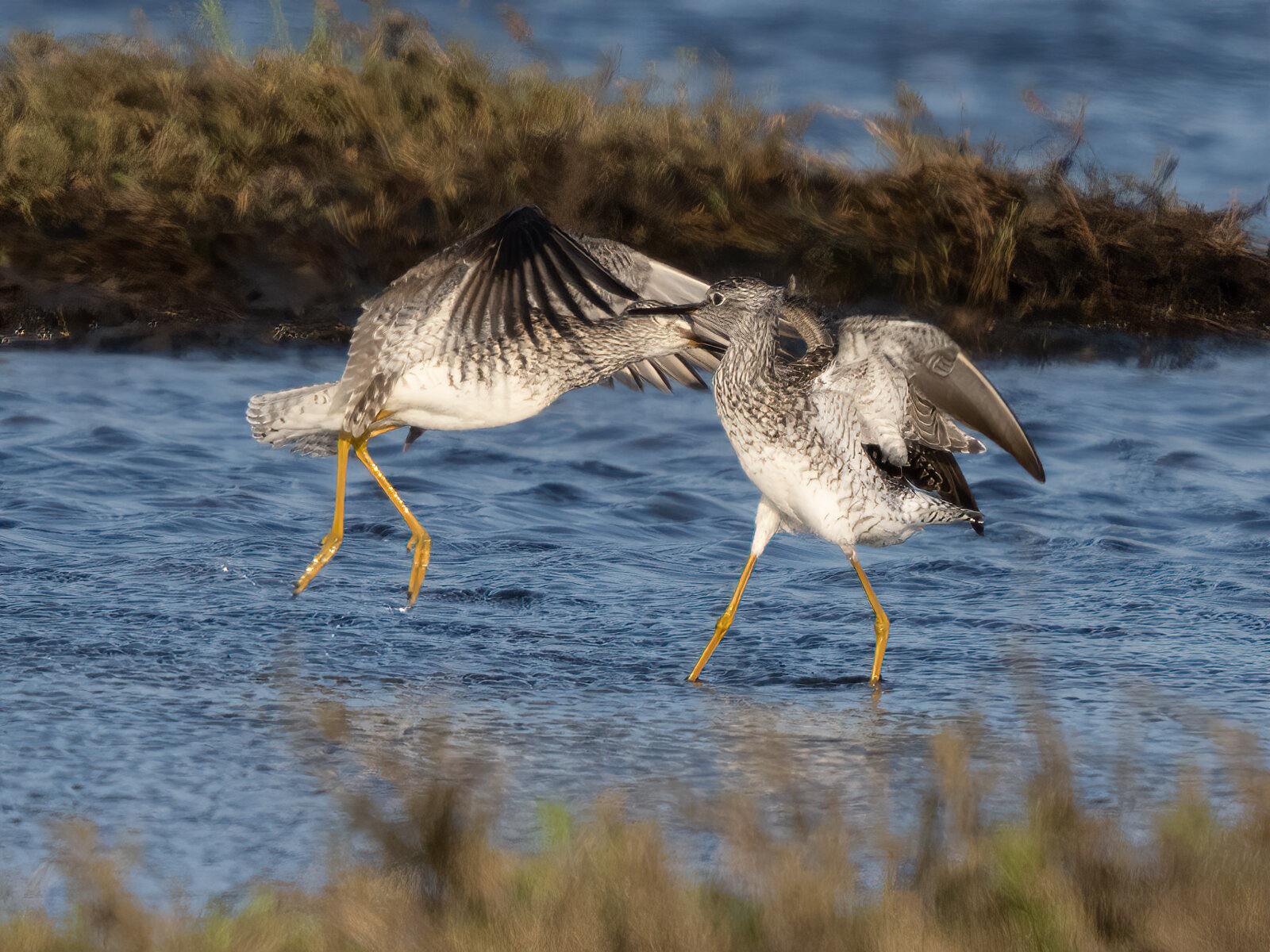
Aggressive territorial disputes by Lesser Yellowlegs at Bolivar Flats in Texas

All photos were taken on April 21, 2021 with an Olympus E-M1X camera and 150-400mm f4.5 TC lens.

CLICK ON IMAGE AND USE RIGHT ARROW TO SEE LARGER VERSIONS OF THE IMAGES.

David Sparks

I retired in 2005 after 40 years of research and teaching at the University of Alabama in Birmingham (24 years), the University of Pennsylvania (8 years) and the Baylor College of Medicine (8 years). Photography is my retirement hobby.

Nature photography, especially bird photography, combines a number of things that I really enjoy: bird-watching, being outdoors, photography, travel, messing about with computers, and learning new skills and concepts.  I now spend much of my time engaged in these activities.

David Sibley in the preface to The Sibley Guide to Birds wrote "Birds are beautiful, in spectacular as well as subtle ways; their colors, shapes, actions, and sounds are among the most aesthetically pleasing in nature."  My goal is to acquire images that capture the beauty and uniqueness of selected species as well as images that highlight the engaging behaviors the birds exhibit. 

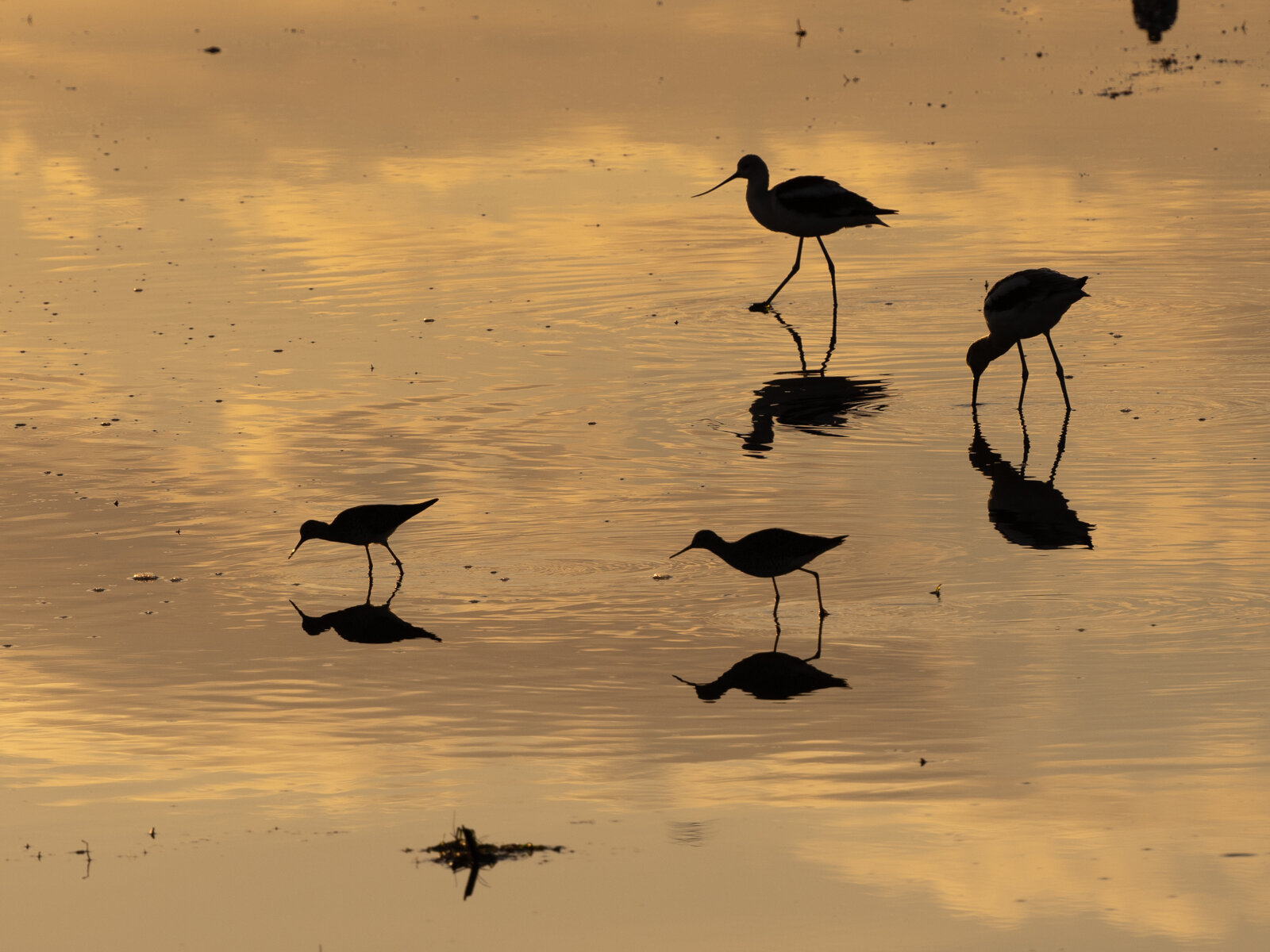
Mostly Avocets - Galveston North Jetty - April 20, 2021

The North Jetty, on the extreme west end of the Bolivar Peninsula, is one of two that protect the ship channel into Galveston Bay. It extends 5 miles into the Gulf. The tide was low during daylight hours and the sun was shining for the first time on my current birding trip.

Six photos taken from the North Jetty on Bolivar Peninsula, TX - April 20, 2021
All were taken with an Olympus E-M1X camera with a 150-400mm f4.5 TC lens.


20210420-P4204418.jpg

David Sparks

I retired in 2005 after 40 years of research and teaching at the University of Alabama in Birmingham (24 years), the University of Pennsylvania (8 years) and the Baylor College of Medicine (8 years). Photography is my retirement hobby.

Nature photography, especially bird photography, combines a number of things that I really enjoy: bird-watching, being outdoors, photography, travel, messing about with computers, and learning new skills and concepts.  I now spend much of my time engaged in these activities.

David Sibley in the preface to The Sibley Guide to Birds wrote "Birds are beautiful, in spectacular as well as subtle ways; their colors, shapes, actions, and sounds are among the most aesthetically pleasing in nature."  My goal is to acquire images that capture the beauty and uniqueness of selected species as well as images that highlight the engaging behaviors the birds exhibit. 

Anahuac NWR - Two of the Things I Had Forgotten

I had forgotten that one of the birding trails at Anahuac NWR had honeysuckle plants growing on both sides for the entire length of the trail. Also, I had forgotten how potent the fragrance of honeysuckle could be.

20210416-P4160566-Edit-3.jpg

I have forgotten the name of this plant. Will look it up when I get home and modify this text then. I have been informed that this is Showy Pink Evening Primrose or Pink Ladies Oenothera speciosa.

David Sparks

I retired in 2005 after 40 years of research and teaching at the University of Alabama in Birmingham (24 years), the University of Pennsylvania (8 years) and the Baylor College of Medicine (8 years). Photography is my retirement hobby.

Nature photography, especially bird photography, combines a number of things that I really enjoy: bird-watching, being outdoors, photography, travel, messing about with computers, and learning new skills and concepts.  I now spend much of my time engaged in these activities.

David Sibley in the preface to The Sibley Guide to Birds wrote "Birds are beautiful, in spectacular as well as subtle ways; their colors, shapes, actions, and sounds are among the most aesthetically pleasing in nature."  My goal is to acquire images that capture the beauty and uniqueness of selected species as well as images that highlight the engaging behaviors the birds exhibit. 

Recent Photos from Texas

I am on my first photo trip since February 2020. It is good to get out of the condo and listen to the imaginary clicks of my mirrorless camera.

Scissor-tailed Flycatcher - Bolivar Peninsula, TX - April 13, 2021
Olympus E-M1X with 150-400mm f4.5 TC lens @ 275 mm
1/1000 sec at f/5.6, ISO 500, handheld


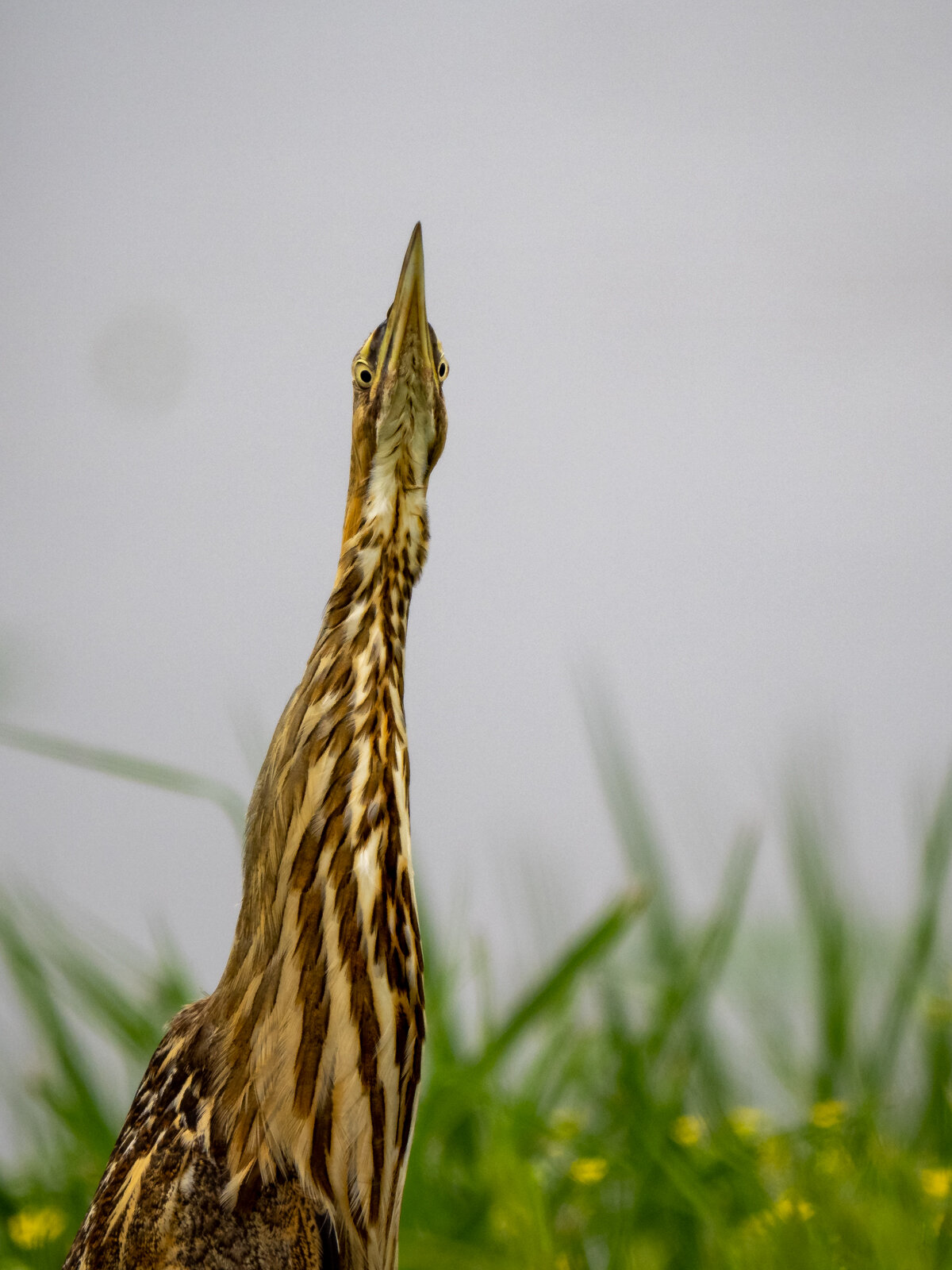
American Bittern- Anahuac NWR, TX - April 13, 2021
Olympus E-M1X with 150-400mm f/4.5 TC lens @ 500 mm
1/640 sec at f/5.6, ISO 250, handheld


American Bittern- Anahuac NWR, TX - April 13, 2021
Olympus E-M1X with 150-400mm f/4.5 TC lens @ 395 mm
1/640 sec at f/5.6, ISO 250, handheld


American Bittern- Anahuac NWR, TX - April 13, 2021
Olympus E-M1X with 150-400mm f/4.5 TC lens @ 500 mm
1/640 sec at f/5.6, ISO 200, handheld


American Bittern- Anahuac NWR, TX - April 13, 2021
Olympus E-M1X with 150-400mm f/4.5 TC lens @ 500 mm
1/640 sec at f/5.6, ISO 320, handheld


American Bittern- Anahuac NWR, TX - April 13, 2021
Olympus E-M1X with 150-400mm f/4.5 TC lens @ 500 mm
1/640 sec at f/5.6, ISO 200, handheld


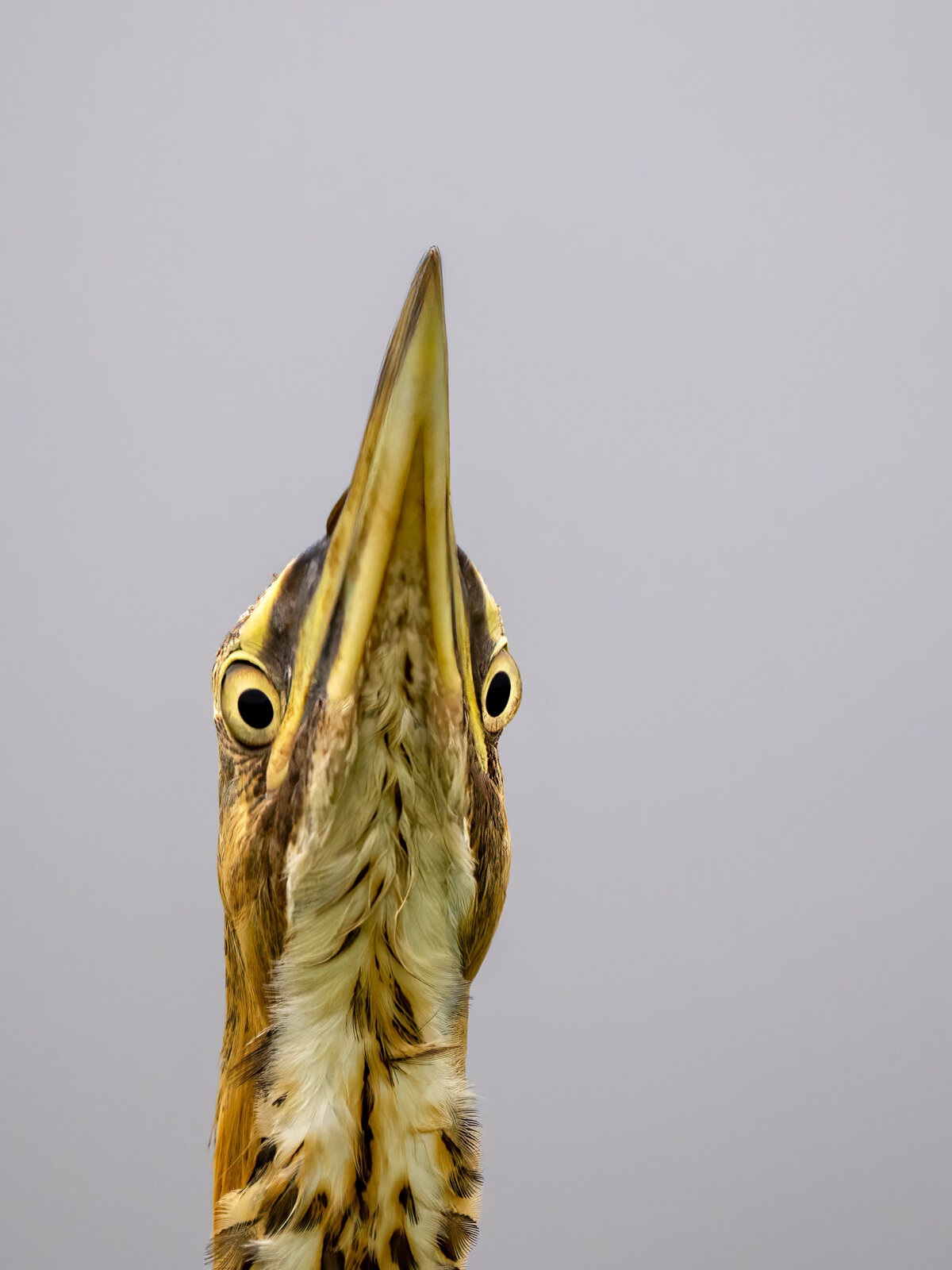
American Bittern- Anahuac NWR, TX - April 13, 2021
Olympus E-M1X with 150-400mm f/4.5 TC lens @ 500 mm
1/640 sec at f/5.6, ISO 250, handheld

David Sparks

I retired in 2005 after 40 years of research and teaching at the University of Alabama in Birmingham (24 years), the University of Pennsylvania (8 years) and the Baylor College of Medicine (8 years). Photography is my retirement hobby.

Nature photography, especially bird photography, combines a number of things that I really enjoy: bird-watching, being outdoors, photography, travel, messing about with computers, and learning new skills and concepts.  I now spend much of my time engaged in these activities.

David Sibley in the preface to The Sibley Guide to Birds wrote "Birds are beautiful, in spectacular as well as subtle ways; their colors, shapes, actions, and sounds are among the most aesthetically pleasing in nature."  My goal is to acquire images that capture the beauty and uniqueness of selected species as well as images that highlight the engaging behaviors the birds exhibit. 

Hooded Mergansers

I found some different subjects for testng the new lens and firmware at Sterne Park on Monday.
Click on the image to see a slightly larger view.

Hooded Merganser - Sterne Park, CO - March 2021
Olympus E-M1X, 150-400mm f/4.5 TC1.25x IS PRO lens @ 473mm, handheld
1/1600 sec at f/5.6, ISO 320


Hooded Merganser - Sterne Park, CO - March 2021
Olympus E-M1X, 150-400mm f/4.5 TC1.25x IS PRO lens @ 500mm, handheld
1/2000 sec at f/5.6, ISO 640

David Sparks

I retired in 2005 after 40 years of research and teaching at the University of Alabama in Birmingham (24 years), the University of Pennsylvania (8 years) and the Baylor College of Medicine (8 years). Photography is my retirement hobby.

Nature photography, especially bird photography, combines a number of things that I really enjoy: bird-watching, being outdoors, photography, travel, messing about with computers, and learning new skills and concepts.  I now spend much of my time engaged in these activities.

David Sibley in the preface to The Sibley Guide to Birds wrote "Birds are beautiful, in spectacular as well as subtle ways; their colors, shapes, actions, and sounds are among the most aesthetically pleasing in nature."  My goal is to acquire images that capture the beauty and uniqueness of selected species as well as images that highlight the engaging behaviors the birds exhibit.